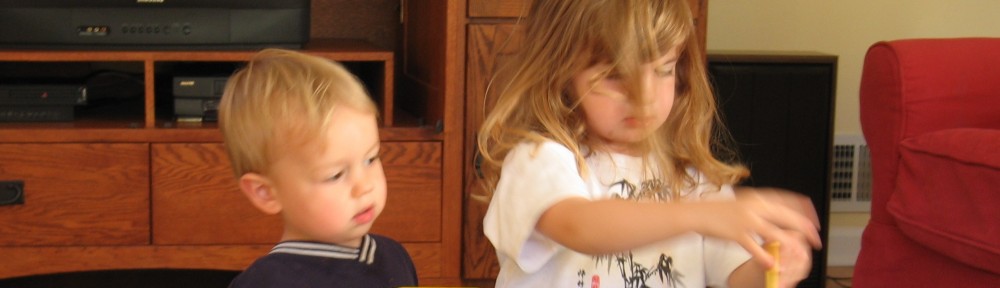
I mentioned something about “unforeseen circumstances,” in that last post, no? Well, as it turns out, Julie is pregnant, with a due date of around September 19. At our age, and under our circumstances, it doesn’t get much more unforeseen than that.
We found out about a month after Christmas, and morning sickness commenced more or less immediately following the positive test result. As with Julia and Joseph, Julie has been effectively overwhelmed by nausea the whole time. We are hoping it might ease up as the pregnancy progresses, but given Julie’s past experience, we’re not that optimistic. She’s been on disability for the past month-and-a-half, so we’ll see how things go when that runs out.
Things have changed a great deal since Julie was pregnant with Joe. Since Julie is well past what used to be the magic age of 35, we assumed going in that she would have to undergo amniocentesis, which poses not insignificant risks for the fetus, not to mention the fact of the giant needle. As it turns out, however, that’s no longer the case: through a combination of blood tests and ultrasounds, Julie’s doctors can learn pretty much everything they previously would have learned from amniocentesis, without all the stabbing.
One optional component of the screening is a new procedure, cell-free fetal DNA testing, that looks at DNA of the baby found floating in the mother’s blood. A small amount of blood is drawn and sent to a lab, where millions of scraps of fetal DNA are analyzed via computer. Based on the proportions of different chromosomes found in this pile of data, doctors can effectively (but not completely) rule out serious chromosomal disorders like Down Syndrome or Trisomy 18, without the risks presented by more invasive procedures.
It’s all pretty magical stuff: the Wired article linked to above estimates that as many 1,000 miscarriages of healthy babies result from amniocentesis and other procedures; many of those could be eliminated by cell-free DNA testing. The one downside is that many insurance policies, including ours, don’t cover the test. We were fortunate to be able to afford to pay for the procedure out-of-pocket.
All the tests so far have come up normal, and the ultrasounds show that everything is coming along according to plan. We’ve posted a few pictures, and hope to have a clip of the baby’s heartbeat online soon.
For the record, thanks to the DNA tests and high-resolution ultrasounds, we know the baby’s sex, but my mother wants to be kept in the dark, so we’re avoiding mentioning it here for the time being.
 Occasional Dispatches from San Jose